Case Management. Verified Care Pathways.
Telephonic care coordination for licensed registered nurses.
Active Telephonic Case Management Roles (10)
Coordinate multi-specialty outpatient care for patients with multi-morbid conditions (CHF, COPD, CKD). Formulate individualized clinical care plans.
Navigate solid organ and bone marrow transplant candidates through pre-transplant workup, Center of Excellence selection, and post-transplant recovery.
Provide dedicated telephonic education, chemo side-effect symptom management, and psychosocial support to oncology patients undergoing active therapy.
Telephonic case management for pregnant Medicaid members with preeclampsia, gestational diabetes, and preterm labor risks.
Coordinate transitions from acute hospitals into skilled nursing facilities (SNF) and long-term post-acute care networks using integrated cloud health data.
Remote patient monitoring and telephonic titration guidance for heart failure (HF) and hypertension (HTN) populations.
Coordinate clinical care and home infusion administration for ultra-rare enzyme replacement, hemophilia, and biologic therapies.
Facilitate return-to-work rehabilitation and clinical treatment authorizations for occupational injury claimants across California.
Support families of children with complex congenital anomalies, tracheostomies, and enteral nutrition needs in community settings.
Flexible 20-hour weekly schedule conducting telephonic health risk assessments for newly enrolled dual-eligible Medicare/Medicaid seniors.
The Expanding Scope of Telephonic Case Management in Value-Based Care
Remote case management jobs are licensed Registered Nurse roles that coordinate outpatient clinical care, manage chronic disease trajectories, and mitigate Social Determinants of Health (SDOH) through telephonic and digital communication. Operating primarily for managed care organizations and commercial health plans, these W2 positions offer daytime schedules, competitive pay ($80,000–$108,000/yr), and require 2 to 3 years of clinical acute experience with CCM certification preferred.
In traditional fee-for-service medicine, healthcare reimbursement rewarded the sheer volume of diagnostic tests, hospital admissions, and surgical interventions. However, the nationwide transition toward value-based care, championed by the Centers for Medicare & Medicaid Services (CMS) and major commercial health plans, has placed outpatient care coordination at the center of financial and clinical strategy.
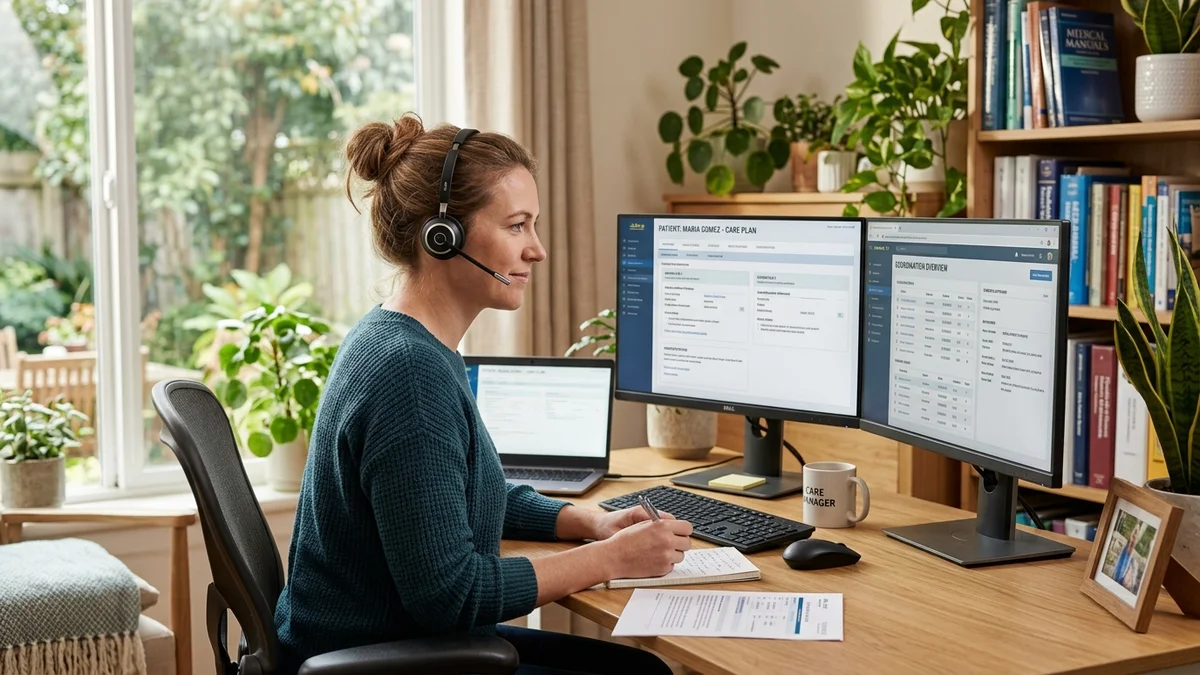
Telephonic Case Management represents the operational mechanism through which health plans achieve the "Triple Aim": improving patient care experience, enhancing population health outcomes, and reducing per-capita medical expenditures. Registered Nurses in case management serve as the primary clinical liaison between patients, primary care providers, medical specialists, and community social services.
Managing Complex Chronic Comorbidities (CHF, COPD, Diabetes)
High-risk case managers specialize in longitudinal disease surveillance for patients managing complex, multi-system chronic illnesses. Patients diagnosed with congestive heart failure (CHF) or end-stage renal disease (ESRD) frequently struggle with complex medication regimens, dietary sodium restrictions, and early symptom recognition.
By establishing scheduled telephonic check-ins, telephonic case managers evaluate subtle biometric shifts (such as a 3-pound overnight weight gain in a CHF patient) and intervene promptly with outpatient diuretic titration orders before the condition decompensates into an emergency department visit.
Mitigating Social Determinants of Health (SDOH)
Clinical research consistently demonstrates that clinical care accounts for only 20% of modifiable health outcomes, while the remaining 80% is driven by socioeconomic and environmental factors. Remote case managers are trained to screen patients systematically for SDOH vulnerabilities: food insecurity, housing instability, utility shut-off risks, and transportation deficits.
Case managers partner with health plan social workers and community non-profits to coordinate medically tailored meal deliveries, arrange subsidized medical transport, and enroll low-income seniors in prescription assistance programs, eliminating the root causes of non-adherence.
The Professional Value of CCMC Certified Case Manager (CCM) Credentialing
While registered nursing licensure authorizes clinical practice, the gold standard professional credential in this field is the Certified Case Manager (CCM), administered by the Commission for Case Manager Certification (CCMC). The CCM examination evaluates comprehensive mastery across five core domains: Care Delivery and Reimbursement Methods, Psychosocial Concepts and Support Systems, Quality and Outcomes Evaluation, Rehabilitation Concepts, and Ethical and Legal Practices.
Employers view the CCM as definitive proof that a nurse understands health plan financial economics, Medicare Advantage star ratings, and NCQA accreditation standards. Candidates who highlight CCM certification, or documented progress toward exam qualification, frequently secure premium starting salaries at the top of corporate pay bands.
📥 Download the 2026 Remote RN Resume & ATS Keyword Checklist
Discover the top 15 Case Management keywords required to pass Workday and Taleo ATS resume screeners.
Download Checklist (Print / PDF) →Frequently Asked Questions About Remote Case Management
01 What are the daily responsibilities of a remote RN case manager?
A telephonic nurse case manager conducts comprehensive clinical and psychosocial assessments of attributed health plan members via phone. Daily tasks include developing individualized care plans, coordinating outpatient specialist appointments, mitigating social barriers (transportation, food security), monitoring medication adherence, and reconciling discharge summaries to prevent hospital readmissions.
02 Is Certified Case Manager (CCM) credentialing required to get hired?
While many employers hire experienced Registered Nurses without the CCM credential, holding or committing to obtain the CCM within 12 to 24 months of hire is standard among top-tier health plans (such as Optum, Humana, and Elevance). CCMC certification typically increases base compensation by $4,000 to $8,000 annually.
03 What acute care backgrounds transition best into telephonic case management?
Inpatient Medical-Surgical, Telemetry, Cardiac Step-down, Oncology, and Home Health nurses excel in case management. Experience in managing complex chronic comorbidities (heart failure, diabetes, COPD, CKD) and coordinating multi-disciplinary discharge plans provides the exact clinical foundation required.
04 How many patient calls does a remote case manager make per day?
Caseload expectations vary by employer and member acuity. On average, telephonic case managers maintain an active caseload of 40 to 75 members and complete between 6 and 12 telephonic clinical encounters per day, with the remainder of working hours dedicated to EHR charting, multidisciplinary care rounds, and community resource coordination.
05 What is the standard salary range for a work-from-home RN case manager?
National compensation for remote RN case managers ranges from $80,000 to $108,000 annually ($38.50 to $52.00 per hour), depending on geographic location, licensure footprint (eNLC compact vs single-state), and clinical specialty certification.