
Work-From-Home Nursing Jobs: The Clinical Bedside Exit Playbook
Bedside exit pathways for registered nurses.
Remote Net Take-Home Pay & Commute Savings Calculator
Empirically calculate true annual net cashflow comparing acute bedside hospital compensation against remote WFH nursing, factoring in IRS mileage ($0.67/mi), hospital parking, uniforms, and meals.
1. Hospital Bedside Compensation
2. Remote Nursing Compensation
3. Hidden Commute & Hospital Costs
Hospital Umbrella vs. Individual Occurrence Malpractice Gap
When transitioning from hospital employment to remote telephonic nursing, understand your liability exposure across state lines.
Hospital / Employer Policy
Claims-Made (Employer Primary)- × Coverage terminates immediately upon your resignation date
- × Zero legal defense for State Board of Nursing license investigations
- × Hospital risk attorneys represent facility interests, not your personal license
- • Cost: $0 (Subsidized under corporate hospital benefits)
Individual Occurrence Policy (NSO / Proliability)
Occurrence-Based ($1M / $6M Limits)- ✓ Lifetime coverage for all encounters occurring while policy is active
- ✓ Up to $25,000 for State Board of Nursing disciplinary defense
- ✓ Independent personal legal representation with zero conflict of interest
- ✓ Fully portable across all 41+ eNLC compact telepractice states
- Annual Cost: $108 – $142 / yr (~$9.50/mo)
Active Work-From-Home RN Positions
Evaluate inpatient acute admissions, level of care, and surgical length-of-stay using InterQual clinical criteria and CMS Two-Midnight guidelines.
Review ongoing hospitalizations for Medicaid and Medicare Advantage enrollees against Milliman Care Guidelines (MCG) to support safe discharge planning.
Perform forensic chart audits on overturned or disputed medical claims. Prepare comprehensive clinical rationales for medical director dispute arbitration.
Weekend asynchronous chart review for emergency department observation vs inpatient placement. Shift differential applied.
Dedicated California HMO utilization management. Review complex tertiary and quaternary admissions for Northern and Southern California regions.
Review elective orthopedic, bariatric, and cardiovascular outpatient surgical requests against clinical coverage policies for Medicare Advantage members.
The Evolution from Inpatient Shiftwork to Remote Corporate Nursing
Work-from-home nursing jobs allow Registered Nurses (RNs) to transition clinical expertise from acute inpatient wards to telecommuting corporate roles in utilization review, case management, phone triage, and medical documentation integrity. These W2 positions require an active RN license, 2 to 3 years of acute bedside experience, and dedicated HIPAA-compliant home office technology.
For decades, registered nursing was virtually synonymous with 12-hour hospital shifts, high patient-to-nurse ratios, physical lifting hazards, and severe emotional exhaustion. However, the modernization of American healthcare operations—accelerated by electronic health records (EHRs), value-based reimbursement models, and remote patient monitoring—has created an unprecedented demand for licensed clinicians operating in corporate, non-bedside capacities.
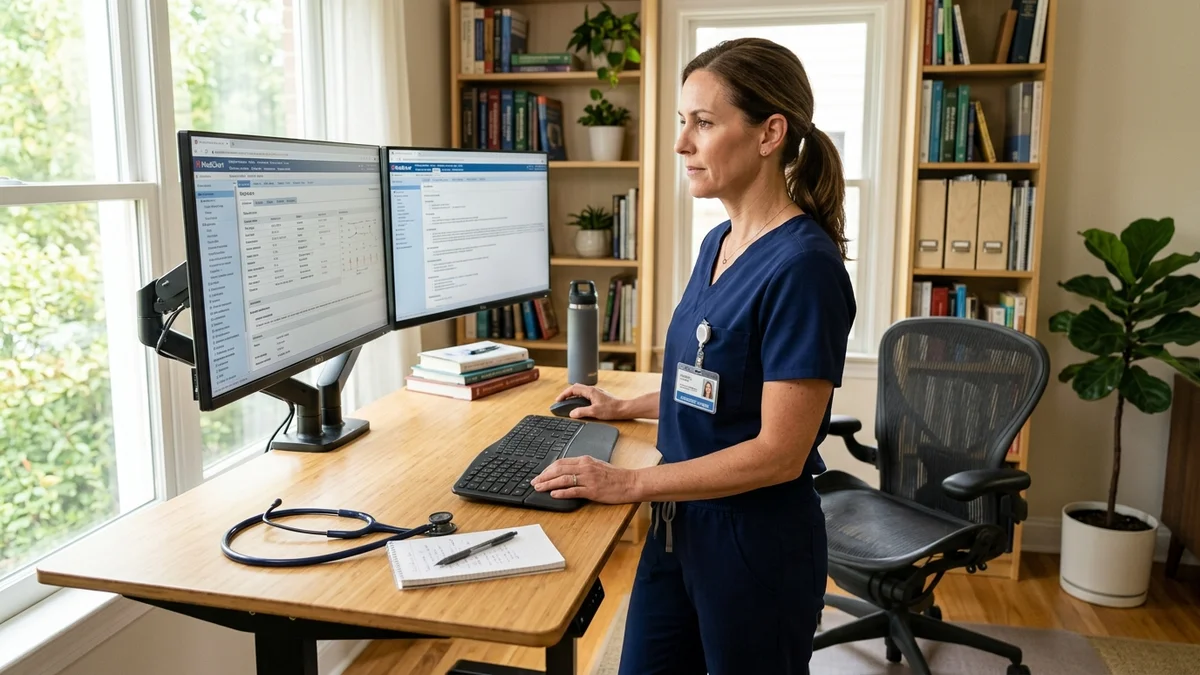
Healthcare payors, third-party administrators (TPAs), managed care organizations (MCOs), and digital health providers require experienced clinicians who possess nuanced clinical intuition to interpret medical records, adjudicate insurance coverage, and guide complex patients through outpatient recovery. A work-from-home nursing career represents a sustainable pivot that preserves professional nursing identity while eliminating occupational physical hazards.
Translating Inpatient Experience into High-Value Corporate Skills
Hospital bedside nurses frequently underestimate how directly their daily ward workflows translate to administrative healthcare operations. Administering complex pharmacotherapy, anticipating surgical complications, and assessing lab trends are directly analogous to conducting medical necessity evaluations in Utilization Review.
Similarly, discharge planning for high-risk congestive heart failure (CHF) or diabetic patients in acute care forms the foundation of Complex Case Management. When tailoring an application for corporate healthcare providers (such as Elevance Health, Centene, or Optum), framing bedside duties in terms of clinical outcomes, length-of-stay reduction, and patient advocacy dramatically enhances recruiter interview invitations.
Home Office HIPAA Compliance Protocols (45 CFR § 164.530)
Federal regulations governing electronic Protected Health Information (ePHI) impose strict physical safeguards on healthcare telecommuters. Under 45 CFR § 164.530(c), healthcare employers must ensure remote employee workstations prevent unauthorized viewing or overhearing of confidential clinical data.
Legitimate remote nursing employers enforce mandatory home office requirements: a dedicated private room with a lockable door, hardwired Cat6 Ethernet (Wi-Fi is prohibited by most major insurers due to packet latency and local interception vulnerabilities), and a dual-ear noise-cancelling VoIP headset. Corporate IT departments issue encrypted laptops configured with enterprise VPNs, preventing local file downloading or screenshot capture.
Financial Realities: Base Pay, Night Differentials, and Net Disposable Income
One of the primary hesitations experienced bedside nurses encounter when contemplating a remote career is the perceived sacrifice of hospital shift differentials. Inpatient hospital nurses working nights, weekends, or preceptor rotations can generate thousands of dollars in shift differentials above base hourly rates.
However, rigorous financial accounting reveals that the net take-home gap between hospital bedside nursing and corporate remote roles is significantly narrower than top-line numbers suggest. According to Bureau of Labor Statistics (BLS) and AAA commuting analyses, the average American nurse commuting 22 miles each way to an acute hospital facility expends approximately $5,600 to $7,800 annually on gasoline, vehicle depreciation (IRS standard rate $0.67/mile), tolls, and hospital parking permits.
When coupled with annual expenditures on specialized clinical scrubs ($400–$800/yr), hospital cafeteria meals, and occupational health expenses, remote nurses often retain a greater percentage of their gross earnings despite transitioning to a daytime corporate salary structure.
📥 Get the 2026 Remote RN Resume & ATS Keyword Checklist
Download our practical translation guide showing exact bedside phrases to replace with corporate InterQual, MCG, and ICD-10 clinical terms to bypass automated ATS filters.
Download Checklist (Print / PDF) →Frequently Asked Questions About Work-From-Home Nursing
01 What is the fastest way for a bedside nurse to transition to a work-from-home role?
The most direct pathway is obtaining 2 to 3 years of acute inpatient medical-surgical, telemetry, or ICU experience, followed by familiarization with corporate clinical decision criteria (InterQual or MCG). Updating your resume to translate bedside clinical interventions into utilization, quality, and compliance metrics significantly improves your match score in corporate Applicant Tracking Systems.
02 Do work-from-home nursing jobs provide equipment, or do I use my personal computer?
Accredited healthcare employers (including UnitedHealth Group, Humana, Elevance, and CVS Health) provide pre-configured corporate laptops, dual monitors, encrypted VPN hardware, and enterprise VoIP headsets. Due to strict HIPAA security standards (45 CFR § 164.530), clinical employees are strictly prohibited from accessing protected health information (ePHI) on personal devices.
03 How do work-from-home nurse salaries compare to hospital bedside pay?
While hospital bedside roles often feature overtime premiums and night shift differentials, remote nurse base salaries ($78,000–$105,000/yr or $38–$52/hr) offer strong compensation parity. When accounting for savings on vehicle commuting (IRS standard rate $0.67/mile), hospital parking, uniforms, and convenience food, remote nurses typically retain 8% to 15% more net discretionary income.
04 Are remote nursing positions strictly 9-to-5 Monday through Friday?
Not necessarily. While utilization review and clinical documentation integrity (CDI) roles commonly follow standard corporate business hours (8:00 AM to 5:00 PM EST), telehealth triage and inpatient concurrent review operations hire for evening, weekend, and flexible PRN coverage with weekend differential compensation.
05 Can I travel or work from coffee shops as a remote Registered Nurse?
No. Federal HIPAA physical security standards mandate that clinical conversations and ePHI displays occur in a private, enclosed room with a lockable door. Public Wi-Fi networks in coffee shops, hotels, or shared workspaces violate healthcare data transmission policies.