eNLC Compact Nursing Jobs: Multi-State Licensure Directory & Reciprocity Guide
Verify multi-state practice privileges across 41 compact member states.
Interactive eNLC Nursing Licensure Reciprocity Map
Click or tap any state to verify remote nursing practice privileges. An active multi-state license issued by your Primary State of Residence (PSOR) authorizes care across all 41 participating compact states.
Ohio (OH)
eNLC Active MemberFull multi-state practice privileges active. Your Ohio RN license authorizes telephonic and virtual nursing practice across all 41+ participating compact states without additional state licenses.
50-State Nursing Licensure Compact (eNLC) Reciprocity Validator
Select your primary state of residence (PSOR) where your Registered Nurse license is held to verify nationwide remote practice authorization.
Ohio (OH)
Full multi-state practice privileges active. Your Ohio RN license authorizes telephonic and virtual nursing practice across all 41+ participating compact states without additional state licenses.
Active eNLC Multi-State Positions
Evaluate inpatient acute admissions, level of care, and surgical length-of-stay using InterQual clinical criteria and CMS Two-Midnight guidelines.
Review ongoing hospitalizations for Medicaid and Medicare Advantage enrollees against Milliman Care Guidelines (MCG) to support safe discharge planning.
Perform forensic chart audits on overturned or disputed medical claims. Prepare comprehensive clinical rationales for medical director dispute arbitration.
Weekend asynchronous chart review for emergency department observation vs inpatient placement. Shift differential applied.
Review elective orthopedic, bariatric, and cardiovascular outpatient surgical requests against clinical coverage policies for Medicare Advantage members.
Manage inpatient psychiatric, residential treatment, and substance use disorder admissions using ASAM and MCG criteria.
The Legal Architecture of Multi-State Remote Nursing Practice
eNLC compact nursing jobs allow Registered Nurses holding a multi-state license issued by their Primary State of Residence (PSOR) to provide telephonic triage, case management, and utilization review across 41 participating compact states. Multi-state licensure eliminates the need to acquire individual state licenses, dramatically expanding remote employment opportunities with nationwide health plans.
The Enhanced Nurse Licensure Compact (eNLC), overseen by the National Council of State Boards of Nursing (NCSBN), represents an interstate agreement enacted into state statutory law. Under this framework, a single multi-state nursing license operates analogously to a driver’s license: issued by your home state, but legally recognized across all 41 participating member jurisdictions.
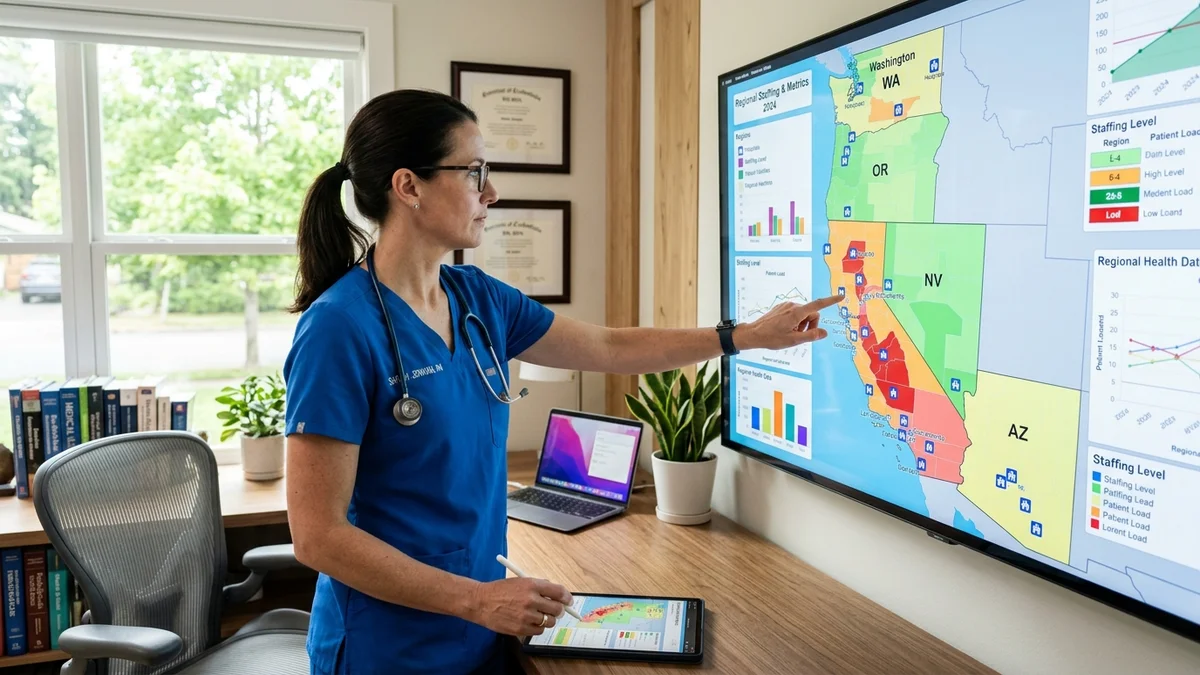
For digital health companies, nationwide commercial payors, and third-party administrators, the eNLC is the backbone of remote clinical operations. Rather than requiring clinical teams to navigate dozens of independent state board applications, background fingerprinting cycles, and continuing education requirements, employers can deploy compact-licensed nurses to manage patient populations across the country immediately upon hire.
The Primary State of Residence (PSOR) Rule Explained
The fundamental statutory principle of the eNLC is the Primary State of Residence (PSOR). An RN can only hold one multi-state license at any given time, and it must be issued by the state where the nurse legally resides. PSOR is legally proven through documentation such as a state driver\'s license, state voter registration card, or state income tax return.
If a nurse moves their permanent legal residence to another compact state, compact bylaws provide a 60-day transition period. During this window, the nurse may continue practicing under the prior home state license while applying for licensure by endorsement in the new state. Failure to transfer licensure within 60 days can result in automatic invalidation of multi-state privileges.
Navigating Single-State Non-Compact Jurisdictions
While 41 states participate in the compact, several prominent healthcare markets—including California, New York, Illinois, Oregon, and Washington State—maintain single-state licensing jurisdictions. These states have historically withheld compact participation to maintain independent disciplinary authority, regulatory oversight, and union staffing ratios.
Nurses who reside in non-compact states are not barred from remote nursing careers. However, their practice scope is governed differently: they hold single-state licenses and can only practice within their home state or in states where they have secured individual single-state license endorsements. Many major healthcare employers actively sponsor and reimburse the cost of securing California or New York endorsements for high-performing remote clinicians.
Cross-Border Practice Liability: Which State Law Applies?
A common misconception among bedside nurses entering remote employment is that their home state Nurse Practice Act governs all clinical interactions. In American jurisprudence, healthcare practice occurs at the physical location of the patient during the encounter.
If an RN in Ohio conducts a telephonic clinical assessment for a patient physically located in Texas, the nurse is practicing in Texas and is legally bound by the Texas Nursing Practice Act and Texas Board of Nursing administrative codes. Remote employers mitigate this risk by developing standardized clinical decision pathways (such as Schmitt-Thompson triage protocols or InterQual criteria) that comply with the strictest regulatory standards across all participating states.
📥 Download the 2026 Remote RN Resume & ATS Keyword Checklist
Includes state-by-state licensure endorsement timelines, fee schedules, and corporate resume translation templates.
Download Checklist (Print / PDF) →Frequently Asked Questions About eNLC Nursing Licensure
01 How do I know if my Registered Nurse license is an active multi-state compact license?
You can verify your multi-state status through Nursys.com QuickConfirm, the official national database for nursing licensure verification. Your report will indicate either "Multi-State" or "Single-State" under the license type column. Multi-state privileges are only issued if your declared Primary State of Residence (PSOR) participates in the eNLC.
02 Can I obtain a compact license if I live in a non-compact state like California or New York?
No. Under NCSBN compact bylaws, eligibility for a multi-state license is strictly tied to your official Primary State of Residence (PSOR). If you legally reside in California, New York, Illinois, or another non-compact jurisdiction, your home state board cannot issue a multi-state license. However, you can apply for single-state licenses by endorsement in individual compact states.
03 What happens to my multi-state remote RN job if I move to another state?
If you relocate to another eNLC compact state, you have a 60-day grace period to obtain a new multi-state license issued by your new Primary State of Residence. You must establish legal residency (driver's license, voter registration, or tax filing) and apply for licensure by endorsement in your new home state.
04 Which state nurse practice act governs my practice during cross-state remote nursing?
Under uniform licensure model rules, nursing practice legally occurs at the physical location of the patient at the exact time of the encounter. Although your license was issued by your home state, you are legally accountable to the Nurse Practice Act, administrative codes, and scope-of-practice statutes of the state where the patient resides.
05 Do nationwide health plans like UnitedHealth Group and Centene require compact licenses?
Yes. Major healthcare payors serving patients nationwide overwhelmingly prefer or mandate eNLC multi-state compact licensure. A compact license allows a single utilization review nurse or telephonic case manager to manage patient caseloads spanning Texas, Florida, Ohio, North Carolina, and 37 other member states without the administrative overhead of maintaining dozens of individual state licenses.